Roots and Revenue: How Five Small Surf Shops Grew Up Without Selling Out
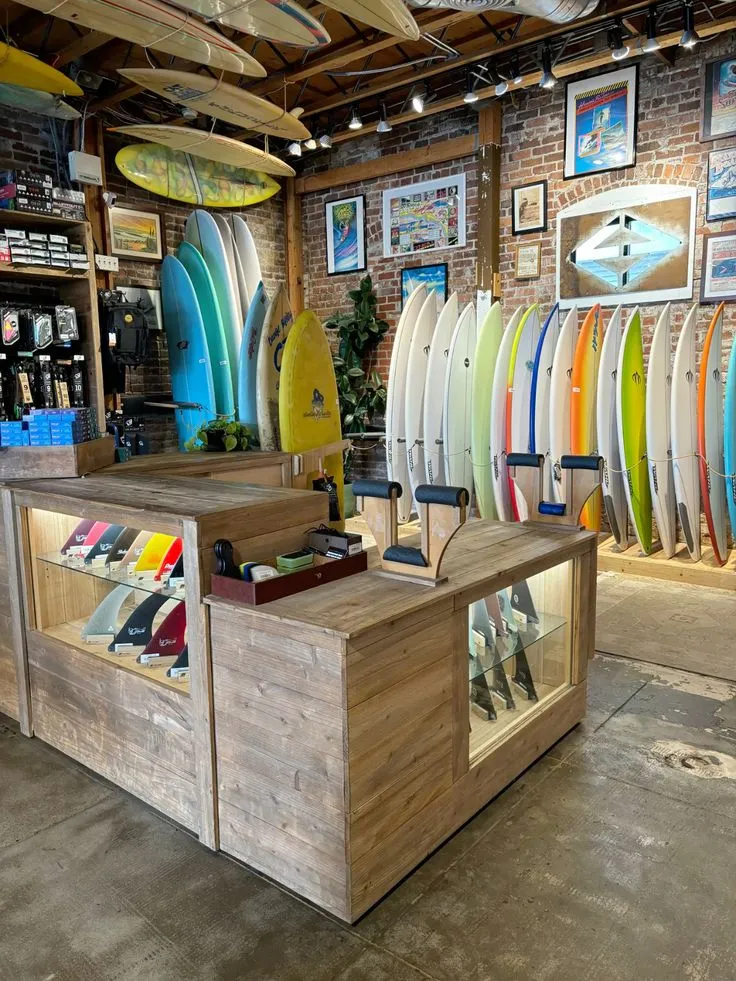
Photo: small independent surf shop interior local business owner boards on wall, via i.pinimg.com
Every surf shop starts the same way: someone who loves the ocean, a space that probably smells like wax and old neoprene, and the vague hope that passion will somehow pay rent. Most stay small. Some close. And a rare few figure out how to grow — not into faceless chain stores, but into something bigger that still feels exactly like themselves.
We tracked down five of those shops across the US, from the Pacific Northwest to the Gulf Coast, and asked them the questions most business profiles are too polite to ask: What did you almost compromise? When did growth feel like a threat? And how do you run an online store without becoming just another drop-shipping operation with a surf logo slapped on it?
The answers were more honest — and more instructive — than we expected.
Coastal Roots Supply, Ventura, California
The pivot that saved them: going deep instead of wide
Coastal Roots started as a board repair and resale operation out of a converted garage in Ventura in 2014. Founder Jake Miramontes had no interest in competing with the big-box surf retailers. "We couldn't win on price and we couldn't win on selection," he says. "So we stopped trying."
Instead, Coastal Roots went narrow and deep, focusing exclusively on locally shaped boards, California-made accessories, and repair services that the chain stores couldn't touch. When they launched their e-commerce store in 2019, they resisted the temptation to stock the same brands everyone else carries. "Our online shop is basically an extension of our repair counter," Miramontes explains. "You can buy a board from us online, but you're also getting the story of who shaped it and where. That's not something Amazon can replicate."
Revenue has grown steadily year over year, but Miramontes measures success differently. "We still know the first name of every person who's bought a board from us. When that stops being true, we'll know we went too far."
Salt Line Surf, Outer Banks, North Carolina
The inventory decision that defined them
The Outer Banks has no shortage of surf shops. What it had a shortage of, according to Salt Line co-founder Priya Nambiar, was shops that took East Coast surfing seriously. "Everyone was stocking for tourists. We decided to stock for surfers."
That meant carrying boards designed for the region's mushy beach breaks, wetsuits appropriate for OBX's actual water temperatures, and refusing to fill floor space with novelty beach gear that had nothing to do with surfing. It cost them tourist dollars early on. It built them a loyal local base that kept coming back.
When Salt Line expanded its online presence during 2020, the team made a deliberate choice: no drop-shipping. Every product in their e-commerce store is physically in their shop. "If we can't touch it, we won't sell it," Nambiar says. "That limits what we can offer, but it means we actually know what we're talking about when someone asks us a question."
Salt Line now ships nationwide, but their product selection still reads like it was curated by someone who's surfed every break between Nags Head and Hatteras. Because it was.
Tideline Surf & Supply, Seaside, Oregon
The community bet that paid off
Owner Cam Yoshida will tell you that Tideline's growth had almost nothing to do with marketing. It had everything to do with a decision made in 2017 to start hosting free surf clinics on the weekends — no purchase required, no email list sign-up, just people learning to surf.
"We gave away a lot of time," Yoshida admits. "But those people became our customers. And more than that, they became our advocates."
Tideline's social media presence grew organically out of that community, with local surfers documenting their own progression and tagging the shop. By the time Yoshida launched a revamped e-commerce site in 2021, there was already an audience that trusted the brand — not because of advertising, but because of what the shop had given them.
The lesson Yoshida is most adamant about sharing: "Don't build an audience. Build a community. The audience comes from that, not the other way around."
Gulf Shred Co., Pensacola, Florida
Saying no to the wrong wholesale deals
Gulf Shred Co. has been approached by almost every major surf brand at some point. They've turned most of them down.
"When a big brand comes in and wants you to carry their full line, they're not doing you a favor," says founder Teri Babcock. "They're using your floor space and your credibility to sell their stuff. And they'll pull out the second a bigger account comes along."
Gulf Shred carries a deliberately curated mix of independent brands, a few regional shapers, and a small selection of soft goods that Babcock sources personally. The shop's buying process is almost comically analog — Babcock visits shapers and small manufacturers in person before agreeing to carry anything.
When they launched online sales, they applied the same filter. "If I can't explain why we carry something in two sentences, it's not on the site," she says. The result is an e-commerce store that's smaller than most but converts at a rate that would embarrass plenty of larger operations. Customers trust the curation because they know it's real.
Breakwater Board Co., San Clemente, California
The almost-franchise moment
Breakwater's story includes a chapter most shops don't talk about: the moment they almost became something else entirely.
In 2018, with two successful locations and a growing online presence, founders Marco and Elena Reyes received a serious offer to franchise the brand. The numbers were good. The structure was there. And after six months of conversations, they walked away.
"We kept trying to explain to these investors what made Breakwater work," Marco says. "And every time we explained it, it became more obvious that it couldn't be franchised. The thing that made it work was us. Our relationships, our taste, our presence in the community. You can't put that in an operations manual."
Breakwater has since focused on deepening rather than expanding — improving their online experience, strengthening supplier relationships, and investing in the staff who carry the shop's culture forward. Elena describes it as "growing inward."
Revenue has continued to climb. More importantly, the shop still feels like the shop.
What They All Have in Common
Five different shops, five different coasts, five different growth trajectories. But a few threads run through all of them.
First: they all know what they are. Not in a rigid, defensive way, but in the sense that they made deliberate choices about what they wouldn't do. Saying no clearly and early turned out to be as important as any yes.
Second: community came before commerce in every case. The shops that grew did so because they gave something real to the people around them first — clinics, curation, expertise, presence.
Third: their e-commerce strategies were extensions of their physical identity, not replacements for it. The online stores work because they feel like the shops. You can sense the same hand behind both.
And finally — maybe most importantly — every single one of these owners talked about their customers by name. Not as a metric. As people.
That's not a business strategy you can buy. It's one you have to build, one session, one sale, and one honest conversation at a time.