The Gunk Beneath Your Feet: What Wax Buildup Is Actually Doing to Your Board
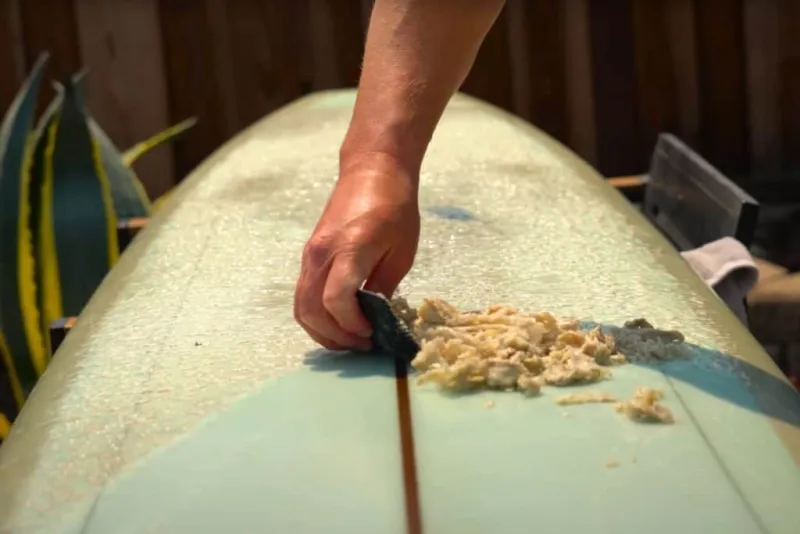
Photo: surfboard wax scraping cleaning deck maintenance, via worldsurfers.com
There's a moment mid-season — somewhere between that early spring swell and the first real summer heat — when your board just starts feeling off. Your pop feels sluggish. Your feet slide at weird angles. You paddle into a clean set wave and the whole thing feels like you're riding a cafeteria tray. You blame your technique, your fitness, maybe the board itself. Nine times out of ten? It's the wax.
Wax buildup is one of the most overlooked performance killers in surfing, and it hits hardest right when the season is getting good. Here's what's actually happening under your feet — and how to fix it.
Why Wax Goes Wrong
Fresh surf wax works by creating microscopic peaks and valleys across your deck. Those tiny bumps grip the soles of your feet and give you the traction you need to drive through turns, stick landings, and stay connected to the board when things get choppy. It's simple physics, and when it's working right, you barely think about it.
The problem is that wax doesn't stay fresh. Every session adds a new layer — sunscreen residue, salt crystals, sand, dead skin cells, and oxidized wax compounds all get pressed into the deck. Over time, those carefully textured bumps collapse into a dense, compacted slab. The surface goes from grippy to slick in ways that aren't always obvious until you're already mid-wipeout.
Heat accelerates everything. If you're surfing anywhere from the Carolinas down to Florida, or out in Southern California during a summer heat dome, your wax is melting and re-solidifying constantly. That repeated thermal cycling breaks down the wax's molecular structure, turning it from a soft, grippy compound into something closer to candle wax — hard, smooth, and basically useless for traction.
There's also a hydrodynamic issue people rarely talk about. A thick, uneven wax job adds weight and drag to the deck of your board. It's not a massive amount, but in a sport where milliseconds and millimeters matter, a bloated wax coat can subtly affect how your board planes, how quickly it responds to rail pressure, and how it moves through the water at speed.
What a Board That Needs Cleaning Actually Looks Like
You don't need to be a shaper to read the signs. Here's what to look for:
Color shift. Fresh wax is white or close to it. Old, oxidized wax turns yellow, gray, or brown. If your deck looks like a dirty cafeteria floor, it's time.
Texture loss. Run your hand across the wax. If it feels more like a smooth, hard surface than a bumpy, slightly tacky one, the grip is gone.
Visible compression lines. Anywhere your feet consistently land — your back foot pad zone, your front foot sweet spot — you'll see flattened, almost polished patches where the wax has been stamped down over hundreds of sessions.
Thickness creep. If you can see the wax from the rails of your board — like it's actually spilling over the edge — you've got too much going on. A healthy wax job sits relatively flat and even.
The sniff test. Old wax smells rancid. Fresh wax smells like coconut or bubblegum depending on your brand. If your nose tells you something's wrong, trust it.
The Cleaning Process, Step by Step
Stripping and re-waxing a board takes maybe 30 to 45 minutes if you do it right. Here's the process that actually works:
1. Use the sun. Set your board in direct sunlight, wax side up, for 10 to 15 minutes. The heat softens the wax without damaging the blank or the glass. Don't leave it too long — you're not trying to melt it completely, just get it pliable.
2. Scrape it off. Use a dedicated wax comb or a plastic scraper — not a metal knife, not your car keys. Work from the nose toward the tail in long, even strokes. The softened wax will come off in sheets and ribbons. Get as much of the bulk off as you can before it re-hardens.
3. Clean the residue. This is the step most people skip, and it's the most important one. Use a wax remover solution — brands like Pickle or Sticky Bumps make good ones — applied with a soft cloth. Rub in circular motions until the deck is completely clear. If you're out of remover, flour or coconut oil work in a pinch to lift the last of the residue, followed by a wipe-down with a clean rag.
4. Inspect the deck. With the wax gone, you've got a clear view of the board's actual condition. Check for pressure dings, delamination bubbles, or cracks that were hiding under the buildup. Now's the time to address those before they turn into bigger problems.
5. Start fresh. Apply a base coat matched to your water temperature, then layer your topcoat in small, circular strokes until you've got even coverage across the areas you actually stand. Don't go overboard — a thin, well-applied coat performs better than a thick, uneven one.
Why Surfers Are Taking This More Seriously
There's a quiet movement happening in performance-focused surf communities across the US — from the Pacific Northwest to the Gulf Coast — where surfers are treating board maintenance less like a chore and more like a craft. Part of it is economic. Quality boards are expensive, and keeping them performing at their best for longer just makes financial sense. Part of it is environmental. Stripping and re-waxing extends the life of a board, which means fewer boards headed to the landfill.
But a big part of it is just about respect for the equipment. When you actually understand what your board is doing — how the rocker interacts with the wave face, how your fins generate drive, how your wax creates the contact point between all of that and your body — you start paying attention to every detail. Wax isn't glamorous, but it's the last link in the chain between your board and your feet.
A clean deck and a fresh wax job won't make you a better surfer overnight. But they will make sure that the board you're riding is actually doing what it was designed to do — which means the only thing holding you back is you.
At Wya Point, we say ride more, live salty, shop local. That starts with showing up to the water with gear that's ready to perform. Don't let something as fixable as a neglected wax job be the reason your sessions fall flat.