That Little Strap Is Lying to You: The Real Cost of a Badly Set Up Leash
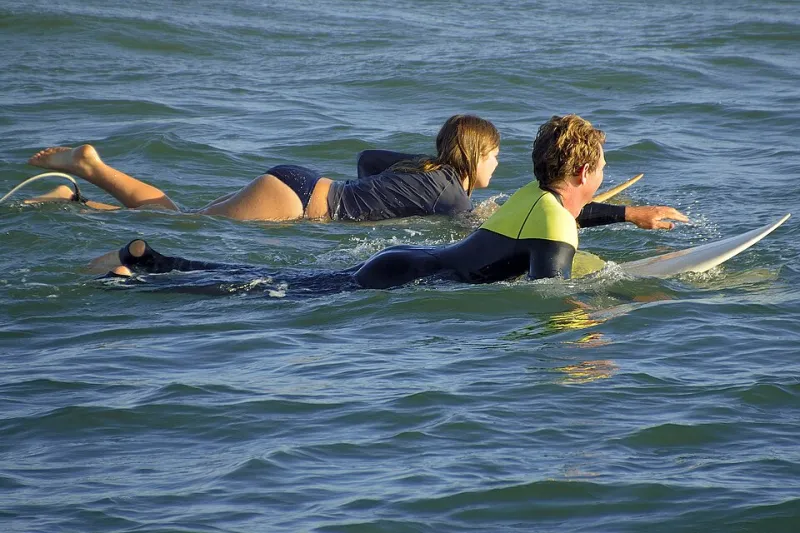
Photo: Mike van Dalen, CC BY 2.0, via Wikimedia Commons
Here's a scenario that happens at pretty much every break in America on any given weekend: someone pearls on a wave, their board rockets toward the beach, and the leash yanks their ankle like a lasso. They swim in, grab the board, look a little shaken, and paddle back out — never once questioning whether the leash itself was part of the problem.
We talk endlessly about fins, wax temps, and rocker profiles. But the leash? It's the piece of gear most surfers set up once, never think about again, and quietly blame something else when things go wrong. Let's fix that.
Length Isn't Just a Number
The standard advice is simple: match your leash length to your board length. Six-foot board, six-foot leash. Sounds clean. It's also only half the story.
Leash length affects how far your board can travel when it gets away from you — and how hard it snaps back. A leash that's too short on a bigger board creates constant tension during turns, adding drag and actually pulling at your back foot mid-maneuver. You might not feel it consciously, but your body does. It's like trying to sprint with a bungee cord tied to your ankle.
On the other end, a leash that's too long creates excessive slack. In powerful surf, that slack becomes whip — the cord stretches, loads up, and when the board reaches the end of its run, it slingshots back with serious force. That's how boards hit surfers, and it's more common than anyone likes to admit.
For most people surfing beach breaks along the East Coast or punchy reef setups in Hawaii or Southern California, matching leash length to board length is a solid baseline. But if you're regularly surfing a board significantly shorter than your height — say, a high-performance shortboard — consider sizing up by six inches. The extra give reduces ankle strain without creating dangerous slack.
Cord Thickness: The Variable Nobody Talks About
Walk into any surf shop and you'll see leashes labeled "comp," "regular," and "big wave." Most people grab regular and call it a day. But cord thickness is actually doing real work, and choosing wrong has consequences.
Thinner comp cords create less drag in the water. That matters more than you'd expect. A thick cord creates measurable resistance during turns and paddle-outs, especially in mushy, slower surf where you're already fighting for momentum. Competitive surfers don't run thin leashes just to look cool — they do it because every little bit of drag reduction adds up over a two-hour session.
But comp cords have a breaking point — literally. In heavy surf, a powerful wipeout can snap a thin leash, and suddenly your board is a projectile. If you're surfing anything overhead or bigger, especially in hollow conditions like Puerto Rico's northwest coast or the outer sandbars off the Outer Banks, step up to a regular or even a big wave cord. The slight drag penalty is worth the security.
A good rule of thumb: match cord thickness to consequence. Small, forgiving surf? Go thin. Powerful, crowded, or consequence-heavy breaks? Go thicker.
The Ankle Cuff: You're Probably Wearing It Wrong
This one stings a little because it's so simple, and yet it's almost universally messed up.
The cuff should sit just above your ankle bone — not mid-calf, not right on the bone itself. Too high and the leash pulls your lower leg awkwardly during pop-ups, subtly throwing off your stance before you've even gotten to your feet. Too low and it slides, bunches, and creates a pressure point that'll have you stopping mid-session to readjust.
The swivel — that small rotating piece where the cord connects to the cuff — should be oriented toward the outside of your ankle, pointing toward your heel side. This lets the cord trail naturally behind you rather than wrapping around your leg during turns. It's a two-second adjustment that immediately changes how the leash behaves.
And the velcro? Pull it tighter than feels comfortable on land. Leashes loosen in the water. If you can slip a finger easily under the cuff when you're dry, it's going to be sloppy when you're wet.
The Rail Saver and the String: Don't Ignore Them
At the other end of the leash, where it attaches to your board, there's a short piece of cord — usually called a leash string or leash tie — that loops through the plug on your tail. This little string takes an enormous amount of stress. It's the anchor point for everything.
Check it regularly. Seriously, look at it before every session if you're surfing anything with real power. A frayed or weakened leash string will snap at the worst possible moment, and unlike a broken cord — which is visible — a failing string often looks fine right up until it doesn't.
The rail saver, the wider fabric piece that sits between the string and the cord, is there to protect your board's rail from the cord digging in during hard wipeouts. If your rail saver is cracked, stiff, or missing, your board is absorbing that force directly into the fiberglass. Replace it before it becomes a ding.
How Often Should You Actually Replace a Leash?
Most surfers replace leashes when they break. That's the wrong answer.
Rubber degrades with UV exposure, salt, and repeated stretching. A leash that's been sitting in the sun on your car roof for two summers might look perfectly fine but have significantly reduced elasticity and strength. That reduced elasticity means it's not absorbing shock the way it should — it's transmitting it directly to your ankle and to the leash plug.
If you surf more than a couple times a month, plan on replacing your leash annually. If you're surfing overhead-plus conditions regularly, every six to eight months is smarter. It's a $20 to $40 decision that protects a board worth ten times that — and protects the people around you.
One More Thing: The Crowd Factor
A properly set up leash isn't just about your performance. It's about everyone else in the water.
A leash that's too long, too loose, or failing can turn your board into a hazard for other surfers. In crowded lineups — and plenty of American breaks are crowded these days — a runaway board is genuinely dangerous. Getting your leash right is part of being a responsible surfer, not just a better one.
Ride more. Set it up right. And maybe check that leash string before you paddle out today.