Before the First Paddle: The Pre-Dawn Habits That Actually Make You a Better Surfer

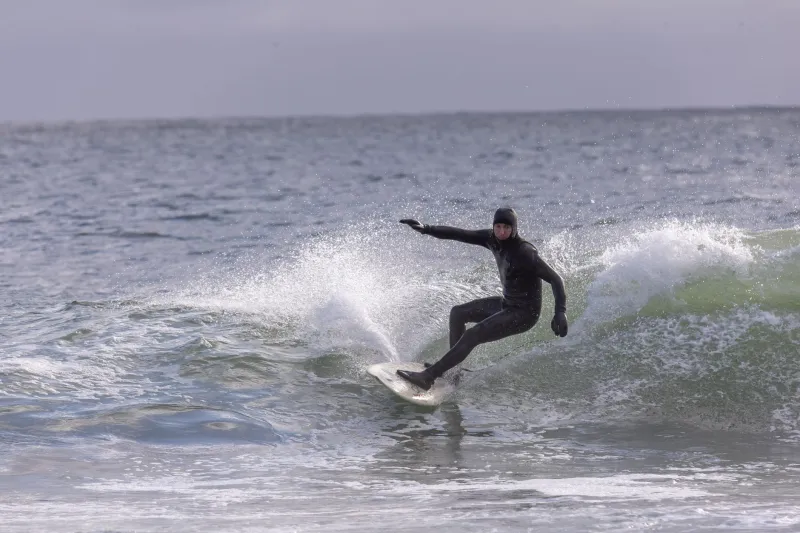
Photo: Sheba_Also 43,000 photos, CC BY-SA 2.0, via Wikimedia Commons
It's 5:47 a.m. The parking lot at your local break is still mostly dark. A few trucks are idling, tailgates down, and the people standing next to them aren't checking their phones. They're watching the water.
That's not an accident. That's a ritual.
The difference between a surfer who shows up and a surfer who performs often has nothing to do with what happens once they're in the water. It's everything that happens in the sixty to ninety minutes before. The wax job. The stretch. The quiet study of how a swell is moving. The mental reset that turns a groggy Tuesday morning into a session worth waking up for.
If you've ever wondered why certain surfers at your local break always seem dialed in from their very first wave, this is why.
The Gear Check Nobody Skips Twice
Ask any experienced surfer about the one lesson they learned the hard way, and there's a decent chance it involves pulling up to a perfect swell and realizing something's wrong with their equipment. A blown fin screw. A leash that's been cracking at the cuff for three sessions. A fresh ding they didn't seal the night before.
Dedicated surfers do a physical gear check before every single session — not because they're paranoid, but because they've been burned. The routine usually takes less than five minutes and covers the basics: leash integrity from plug to cuff, fin box tightness, board rails and deck for any new pressure dings or delamination, and the wax job.
The wax deserves its own mention. A lot of casual surfers treat wax like an afterthought — slap some on when it looks thin, call it done. Committed surfers treat it like tire maintenance. They're scraping and reapplying based on water temperature, checking that their base coat is still doing its job, and making sure the texture is right for their stance and style. It sounds obsessive until you've slipped off your board on a wave that mattered.
Stretching Isn't Optional, It's Insurance
Surfing is a full-body workout that asks your body to move in ways most people don't do at any other point in their week. Paddling torches your shoulders, lats, and lower back. Popping up demands hip flexor mobility and explosive leg strength. Riding a wave through a bottom turn and back up to the lip engages your core in ways that would surprise most gym-goers.
The surfers who last longest — both in a single session and over a lifetime of surfing — take their warm-up seriously. Not gym-serious, but intentional. A ten-minute routine that hits the hips, rotator cuffs, thoracic spine, and hamstrings can be the difference between a two-hour session and one that ends with a tweak in your lower back at wave number four.
Down in San Diego, up in Santa Cruz, out on the Outer Banks — the surfers who are still ripping in their fifties and sixties almost universally have some version of a morning movement practice. It doesn't have to be yoga. It just has to happen.
Reading the Break Before You're In It
This one is where casual surfers lose the most ground without realizing it. Paddling out without watching the water first is like driving a route you've never been on without checking the map. You might get there, but you're going to miss things.
Experienced surfers spend real time on the beach before they ever put a foot in the water. They're watching where the sets are breaking, identifying the rip currents, clocking the interval between waves, figuring out where the crowd is sitting and where there might be an open peak. They're also watching how other surfers are moving — what lines they're taking, where they're getting caught inside, what the current is doing to paddle-out routes.
This is local knowledge in action, and it's one of the things that separates surfers who are deeply connected to a specific break from those who show up once in a while and wonder why they can't find rhythm. You can accelerate this process by talking to people who surf your spot regularly, checking forecast apps like Surfline or Magic Seaweed the night before, and simply logging time observing before paddling.
Swell direction, tide stage, wind — these aren't just numbers on a screen. They're the language of the ocean, and reading them fluently takes practice that starts on the sand.
Getting Your Head Right
This is the part that feels soft until you realize how much it matters.
Surfing is a sport with an unusually high cognitive load. You're making split-second decisions about which waves to take, where to position yourself, how to navigate a crowd, when to pull back and when to commit. That decision-making is significantly sharper when your mind is calm and focused rather than scattered.
A lot of serious surfers have some version of a mental preparation practice baked into their morning. It might be as structured as five minutes of breathwork in the parking lot. It might be as simple as leaving the phone in the car, drinking coffee in silence, and just watching the ocean. Some surfers journal. Some listen to a specific playlist. Some just sit with the sound of the water.
The point isn't the method — it's the intention. You're transitioning from whatever your life demands of you the rest of the day into a headspace where you're present, aware, and ready to read and respond to the ocean in real time.
The Compound Effect of Consistent Preparation
None of these habits are complicated. A gear check. A stretch. Time spent watching the break. A few minutes of mental stillness. On their own, each one seems almost too simple to matter.
But here's the thing about rituals: they compound. The surfer who does all of these things consistently, session after session, is building a set of reflexes and a quality of attention that shows up in the water in ways that are hard to quantify but impossible to miss. They catch more waves. They make better decisions in critical moments. They stay healthier and surf longer into their lives.
They also tend to enjoy surfing more — because preparation creates confidence, and confidence creates flow.
At Wya Point, we talk a lot about riding more and living salty. That's not just about time in the water. It's about how seriously you take the whole practice of surfing — the gear you trust, the knowledge you build, the habits you keep even when no one's watching.
The ocean rewards preparation. Start the night before. Show up early. Watch before you paddle. Your sessions will tell the difference.