You're Stripping Your Board Wrong — And It's Slowly Wrecking It

Photo: Lionel Walden; and François Antoine Vizzavona??? [1], Public domain, via Wikimedia Commons
Every surfer knows the ritual. Wax builds up, the deck gets grimy, and eventually you drag out a comb or a credit card and go to town. Ten minutes later the board looks cleaner, you toss it in the car, and you're done. Simple enough, right?
Not quite. What most surfers don't realize is that the way they clean their boards — the tools they use, the products they reach for, the timing, even the temperature — can quietly chip away at the materials underneath. Fiberglass delaminates. Epoxy yellows and weakens. Foam absorbs solvents that were never meant to touch it. By the time the damage shows up, it's usually too late to reverse it without a serious repair job.
Board care isn't glamorous. But getting it right is one of the cheapest ways to extend the life of a board you've already invested in — and it's something the surf industry doesn't talk about nearly enough.
The Problem With How Most People Remove Wax
The typical approach: scrape hard, scrape fast, call it done. And yeah, that gets the bulk of it off. But aggressive scraping with the wrong tool — especially a metal edge or anything with a sharp corner — can scratch the laminate, create micro-abrasions in the glass, or even gouge softer epoxy boards if you're not careful.
Polyester (traditional fiberglass) boards are a little more forgiving. Epoxy boards, which have become increasingly common and are generally more environmentally friendly to produce, have a slightly softer outer layer that's more vulnerable to mechanical damage. If you've ever seen fine scratches all over a board's deck that don't quite look like pressure dings, there's a good chance it's wax removal damage.
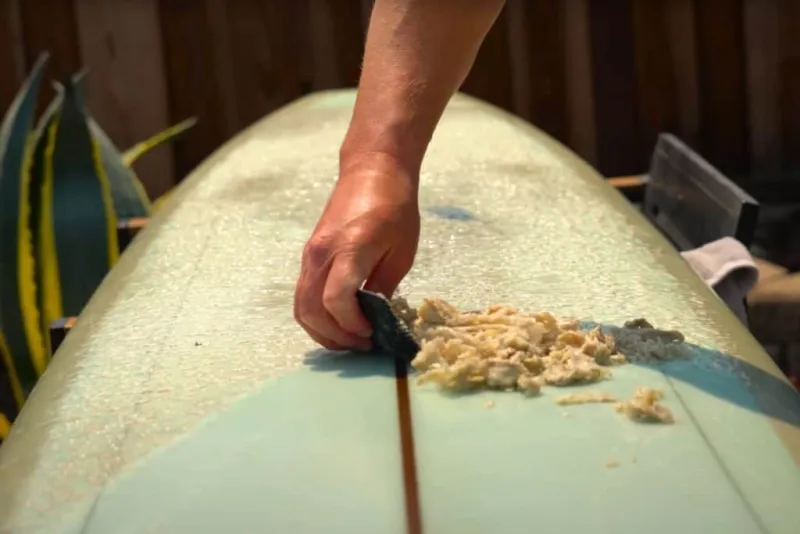
The fix is simple: use a proper plastic wax comb, hold it at a low angle, and let the tool do the work rather than forcing it. You're not trying to sand the board — you're lifting the wax off the surface.
Heat Is Your Friend, But Only Up to a Point
Here's a trick shapers and board builders actually use: warm the wax before you try to remove it. A few minutes in direct sunlight or a quick pass with a hair dryer on low heat softens the wax so it peels off in sheets rather than crumbling into a thousand sticky pieces you'll be finding in your car for months.
But there's a ceiling on how much heat you want to apply, especially with epoxy boards. Epoxy resin has a lower heat tolerance than polyester, and leaving a board baking in a hot car or blasting it with a heat gun can actually cause delamination — that bubbling, soft-spot effect where the glass separates from the foam underneath. Some epoxy boards will start to show stress at temperatures you'd hit on a summer afternoon in a dark vehicle.
The move: warm the board gently, strip the bulk of the wax while it's soft, then let the board cool before doing any detail work. Never use a heat gun unless you really know what you're doing and you're working with a polyester board.
What's Actually in That Wax Remover?
Once the bulk wax is off, a lot of surfers reach for a commercial wax remover or, worse, something from the garage — acetone, paint thinner, lighter fluid. This is where real damage happens.
Acetone, in particular, is extremely aggressive. It will absolutely strip wax residue, but it'll also attack the resin underneath, especially on epoxy boards. Over time, repeated acetone exposure can dull the finish, weaken the resin matrix, and potentially compromise the board's structural integrity in ways that aren't immediately visible.
The better options are citrus-based cleaners or dedicated surf wax removers that are formulated to cut through wax without eating into the laminate. Some shapers use a light application of coconut oil to lift the remaining wax residue — it sounds counterintuitive, but it works and it's gentle. You wipe it off with a clean cloth and follow up with a mild soap-and-water rinse.
If you're going to use any kind of solvent, test it on a small, inconspicuous area first. And if you're working on an epoxy board, skip the harsh chemicals entirely.
Cleaning the Rails and the Bottom
Most surfers focus almost entirely on the deck, which makes sense — that's where the wax lives. But the rails and bottom of the board collect salt, sand, and oxidation that can affect both aesthetics and performance over time.
Salt crystals are abrasive. When they dry on the surface of a board and you toss it into a board bag or lean it against another board, they act like sandpaper. A simple freshwater rinse after every session is the most underrated maintenance habit in surfing. Not a full cleaning — just a rinse. It takes thirty seconds and it makes a meaningful difference over the life of a board.
For the bottom, a gentle wipe-down with a damp cloth and mild dish soap every few weeks removes oxidation and keeps the surface cleaner for fin box maintenance. Speaking of which — fin boxes are a commonly neglected area where salt and debris accumulate and can eventually make fins difficult to seat properly or cause the box to crack under pressure.
Dings, Cracks, and the Cleaning Mistake That Makes Them Worse
This one is critical: never apply any liquid cleaner — even water — to an open ding before it's been repaired. Foam is porous. Once the laminate is compromised, water and solvents wick directly into the blank and can cause the foam to yellow, soften, or delaminate from the inside out. You won't see it happening. You'll just notice one day that the board feels different, or that a ding you thought was cosmetic has turned into a soft spot.
Check your board for dings before every cleaning session. Anything that's broken through the glass needs to be dried out and sealed before the board goes anywhere near water or cleaning products. Even a temporary patch of waterproof tape is better than nothing while you wait to do a proper repair.
Building a Real Maintenance Routine
The surfers who get the most out of their boards aren't necessarily the ones with the most equipment — they're the ones who treat what they have with a little respect. A basic routine doesn't take long:
- After every session: Freshwater rinse, let it dry in the shade (not direct sun if it's an epoxy board).
- Monthly: Full wax strip with proper tools, gentle citrus-based cleaner, check rails and fin boxes.
- As needed: Inspect for dings, repair before the next session, don't let water get into open damage.
That's it. No special products, no complicated process. Just consistency.
At Wya Point, we've seen too many solid boards get retired early because of preventable damage. The ocean is hard enough on your equipment without adding bad habits on top of it. Ride more, take care of your gear, and the board will take care of you.