Soft, Hard, or Somewhere in Between: How to Stop Buying the Wrong Surf Wax for Your Local Water
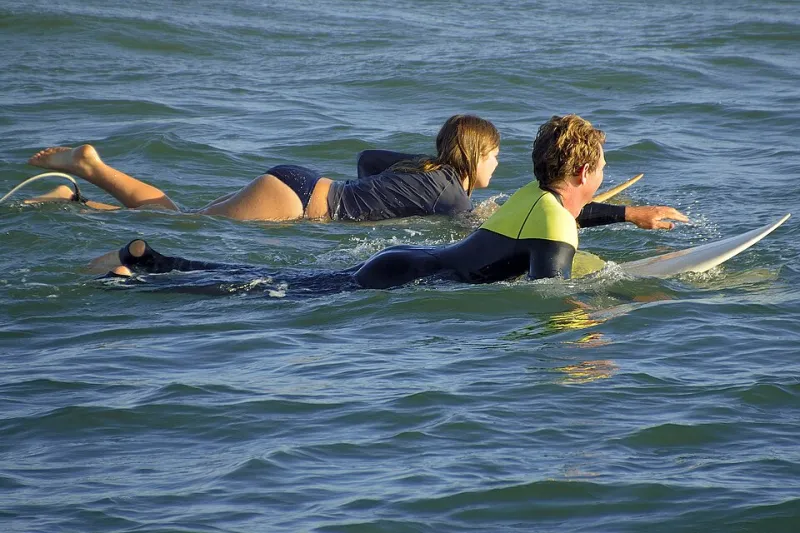
Photo: Bill Abbott, CC BY-SA 2.0, via Wikimedia Commons
You've done it. We've all done it. You grab whatever wax block is sitting near the register, rub it on, paddle out, and wonder why your back foot keeps sliding off the tail like you're standing on a greased dinner plate. Nine times out of ten, the culprit isn't your stance or your board — it's the wax. Specifically, it's wax that was designed for water your local ocean has never seen.
Surf wax is one of those things that looks simple until you actually think about it. Paraffin, a few additives, maybe some fragrance so it smells like coconut on a shelf. But behind that humble block is a chemistry problem that plays out differently depending on whether you're surfing the 58°F grays off Northern California or the 82°F bathwater around South Florida in August. Get it wrong, and you're either skating on slick nothing or chipping through a wax job that's gone rock-hard and crumbly.
Let's break down why this happens — and how to actually fix it.
Why Wax Behaves Differently in Different Temperatures
All surf wax has a melting point, but that number isn't a cliff edge — it's more of a sliding scale. As water temperature rises, even wax that's technically "below" its melting point starts to soften, lose cohesion, and spread into a thin, slippery film rather than the bumpy, grippy texture you actually want underfoot. In colder water, the opposite problem kicks in: wax that's too hard won't activate properly. It sits on your board like a layer of crayon, refusing to form the small peaks and ridges that create traction.
Most wax manufacturers label their products along a rough spectrum — cold, cool, warm, and tropical — and those categories do correspond to real formulation differences. Cold-water wax uses softer, lower-melting-point compounds so it stays pliable in frigid conditions. Tropical wax is blended with harder paraffins specifically to resist the softening effect of warm ocean water. The problem is that "warm" covers a huge range depending on where you live, and regional variation in US coastal waters is enormous.
What US Coastal Waters Actually Look Like by Season
Here's where it gets practical. The US coastline is not a monolith, and treating it like one is exactly why surfers from Maine to Maui end up using the wrong product.
Pacific Northwest and Northern California (roughly above San Francisco): Water temperatures typically sit between 48°F and 58°F year-round, with some variation by season. Cold-water wax is almost always appropriate here. In the summer months, a cold-to-cool formula can work, but you're rarely pushing into warm territory.
Central and Southern California: This is where people get confused most often. Summer water temps in SoCal can climb into the low-to-mid 70s, especially after a warm spell. That's warm wax territory. But come winter, the same breaks can drop into the low 60s or even high 50s on a cold year — suddenly your tropical block is a hockey puck. The cool-water range is your year-round anchor here, with a shift toward warm in peak summer.
The Gulf Coast (Texas, Louisiana, Florida Panhandle): These waters run warm for a long portion of the year, often sitting in the mid-70s to low 80s from late spring through early fall. Warm or tropical wax is appropriate for most of the warm season. Winter brings it down into the 60s, where a cool-water formula becomes more relevant.
East Coast, Mid-Atlantic (New Jersey to the Carolinas): Possibly the most dramatic seasonal swings in US surf. New Jersey water can drop below 40°F in February and climb past 75°F in late August. That's a spread that spans nearly every wax category. Surfers here genuinely need to stock multiple types and rotate them seasonally — cold in winter, cool in spring and fall, warm in summer.
Florida's Atlantic Coast and the Keys: Consistently warm, often tropical. If you're surfing Sebastian Inlet in August, you want tropical wax, full stop. Anything softer is going to turn to grease.
The Basecoat Variable Nobody Talks About Enough
One thing that gets lost in the temperature conversation is the role of basecoat. A good hard basecoat — applied regardless of your local water temp — gives your topcoat something to grip. Without it, even the right temperature-rated wax can slide around or wear off faster than it should.
Basecoat is always formulated hard. It's not meant to provide grip on its own; it's meant to create texture for your topcoat to bond with. Think of it like priming a wall before painting. Skip it, and you're working harder for a worse result. A lot of surfers who complain about wax performance in changing seasons are actually dealing with a basecoat problem as much as a formula mismatch.
Apply a fresh basecoat at the start of each season when you're doing a full strip-and-rewax. If you're just topping up between sessions, a light crosshatch of your temperature-appropriate topcoat is usually enough.
A Simple Field Test to Check Your Wax
Not sure if your current wax is right for your conditions? Try this before your next session. Pull your board out of the bag or off the roof rack after it's been sitting in the sun for 10–15 minutes — simulating a typical pre-session wait. Run your thumb firmly across the wax surface. If it smears easily into a flat film, it's too soft for your conditions (or it's been sitting in the sun too long, which is a storage issue worth addressing separately). If it barely marks and leaves no texture impression at all, it's too hard.
You're looking for wax that yields slightly under firm thumb pressure, leaving a visible mark but not spreading or balling up. That's the texture that's going to translate into actual grip when your feet hit the deck.
Matching the Block to the Break
Here's a quick reference to keep in your head when you're standing in the shop:
- Water below 58°F → Cold water wax
- 58°F to 68°F → Cool water wax
- 68°F to 75°F → Warm water wax
- Above 75°F → Tropical wax
Check your local water temperature before you buy, not the air temperature. These are different numbers, and air temp is basically irrelevant to your wax choice. Most surf forecasting apps and sites (including the wave forecasts we run here at Wya Point) will give you current and projected water temps for your break. Use them.
The Seasonal Rotation Habit Worth Building
The surfers who consistently have good wax jobs aren't spending more money — they're just being more intentional about timing. A full strip and rewax at the start of each major season, with a wax type matched to the water conditions for that stretch of the year, is a habit that costs almost nothing extra and pays off every single session.
Keep a cold block and a warm block in your bag if you travel. If you're a SoCal regular who takes a January trip to the North Shore, don't assume your warm-water wax is going to translate — it won't. And if you're heading to Costa Rica from the Pacific Northwest in March, leave the cold-water block at home.
The ocean doesn't care what wax you have. Match the water, and it'll take care of the rest.